
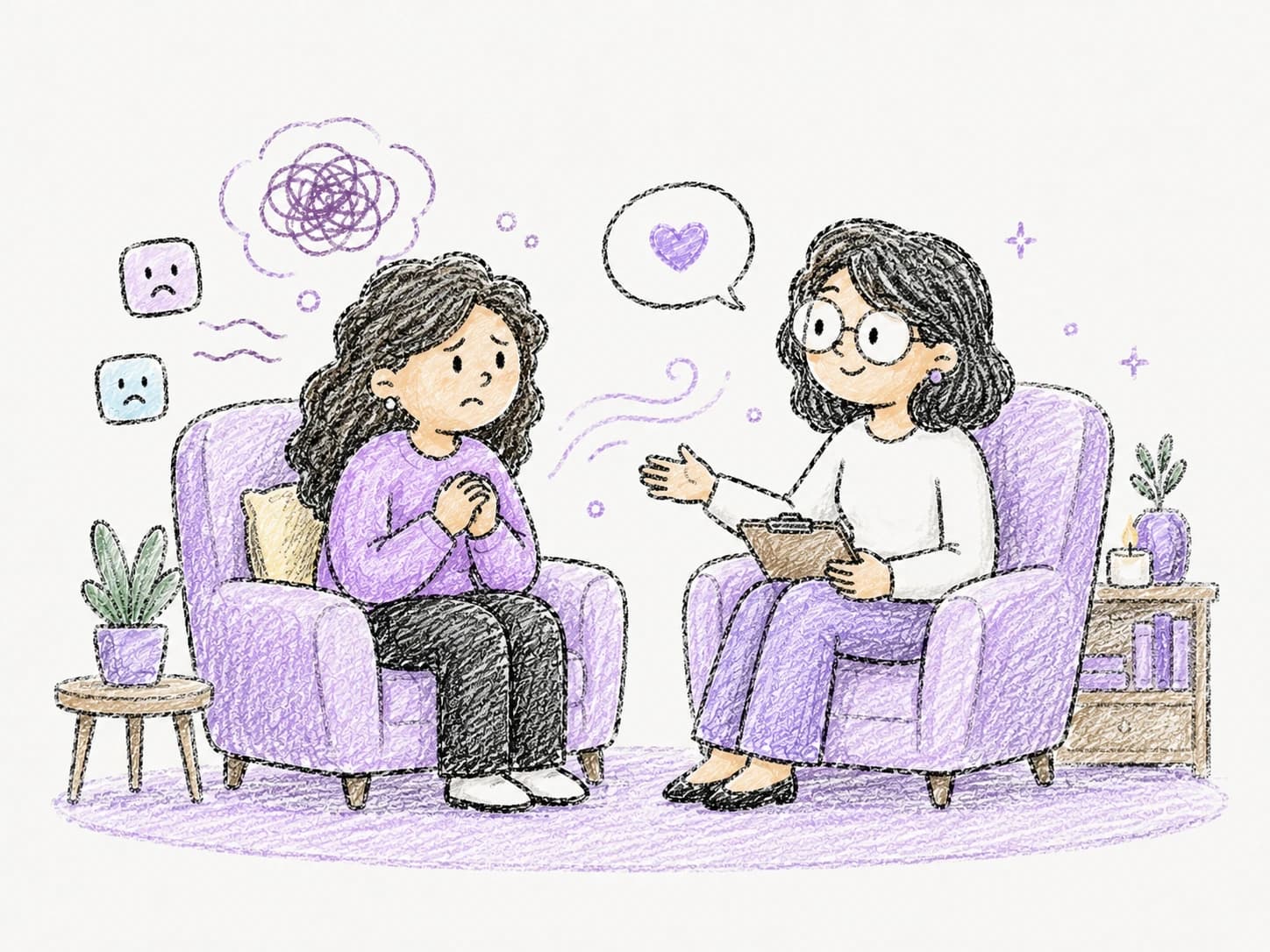
Emotionally Focused Couples Therapy Therapists in Canada
An evidence-based approach to couples therapy that helps partners understand the emotional cycles driving conflict and build a more secure, responsive bond.
What to look for in an Emotionally Focused Couples Therapy therapist on Purple Lotus
- EFT training or certification through ICEEFT or an affiliated centre
- Experience with your specific concern, such as distance, infidelity, or anxiety in the relationship
- A balanced approach that treats both partners fairly
- Comfort working with emotion and attachment rather than only communication skills
5 therapists for Emotionally Focused Couples Therapy in Canada
Browse 5 therapists offering Emotionally Focused Couples Therapy. Find the right counsellor or psychotherapist for your needs.

Cordelia Mejin
Hi, I’m Cordelia and I’m honoured that you are here. I desire to provide gentle and compassionate care, empathy and a safe place as I believe that we as humans have longings to feel seen, heard, known, understood, felt, accepted, and cared for, especially in difficult moments. The one thing that remained constant throughout my life is that I have always found meaning in connecting with others on an authentic, deep, heart level and in making meaningful impact in the lives of others. A longing to lead a life in alignment with who I am at the core of my being led me to pursue counselling not just as a profession, but as a calling and passion. I love what I do and am honoured that I get to hold space for my clients and see transformation happen in their lives. It makes my heart full to know that I am making a daily difference, one person at a time. I consider it an honour to walk alongside you and to meet you where you are at – be it a time when you are navigating everyday difficulties, a time when you feel lost, a time of grief, loss and transitions, a time when hope feels out of reach, or a time when you find that you are desiring growth and change within yourself and in your relationships. Although I am experienced in my work a generalist, I have specialized training and extensive experience in the area of grief and loss. Additionally, I have special training and extensive experience in various areas of concern. My personal experience of grief and painful loss of my family member’s death led to my deep devotion and passion to people who are grieving a death and/or non-death losses. Through my own journey of integrating grief into my life story, I developed a strong desire to support others in carrying their grief, remembering their person and integrating their grief into their life story. As one who grew up in a multicultural community, I have strong cultural awareness and strive to provide culturally sensitive therapy from a place of cultural humility. I value holding space for your story to be told and acknowledged in a supportive space where your experiences are validated, honoured, processed and integrated into your life story in a way that is fitting for you. In sharing your stories and allowing them to be witnessed in the presence and safety of a therapeutic relationship, it is my hope that what may have once felt unbearable becomes less heavy and eventually more bearable. On A Personal Note As one who is nearing my mid-30s, I have navigated various challenges, including life transitions, chronic pain, endometriosis and grief of all kinds (death and non-death losses). I cherish beautiful moments that unfold in life while also seeing the value of holding space for feelings that emerge from the difficult places of life. It is from my lived experiences and my own human-ness that I draw my compassion for each person I encounter in the therapy room. I live in beautiful British Columbia with my husband whom I have been married to for almost a decade. I treasure spending quality time with my family and friends. I am an avid reader, and am most fulfilled when I am outdoors in nature. I enjoy hiking, biking, playing the piano, listening to music and visiting new places around the world. I look forward to getting to know you and to connecting with you. It is my honour to meet you. Warmly, Cordelia

Maitri Gupta
Starting therapy is daunting. Existing in this world is not easy! There is much uncertainty and hurt. I congratulate you for taking the initial steps to find the right fit for you. I believe that everyone has the right to healing and community. We heal in community. The work I do with my clients in essence is relational. The work you will do in therapy is a radical act of self-advocacy in a world that often demands from us productivity and perfectionism. As a social justice activist, yogi, and post-modernist my approach to healing work is holistic. I aspire to go beyond the medical model and do not conform to what the norm demands from us. As your therapist, I engage with you curiously to go deeper, exploring many aspects as you unpack the layers of your narratives. Healing can only begin when we separate who we are from our problems. Coming from a bi-cultural background, I believe the narratives we have to speak to our individualistic and collective experience of events. It is vital to look within and around the communities to which we belong. I can provide services in Hindi, Punjabi, and English. My goal as a therapist is to facilitate mindful exploration of your trauma in a safe, collaborative, and open space. I want to hear your stories. Revisiting painful, challenging, and stressful stories can be a complex process. You are not alone! We work at your pace to restore your agency so that you can reclaim the narratives that serve your interpersonal growth and well-being. Through a trauma-informed lens, together, we can unpack: Anxiety and Low Moods Addictions Abuse Sexuality Social Anxiety Self-esteem and self-worth Burnout Challenges around social justice advocacy and activism Fear and hopelessness Body Image Self-Care Chronic Illness Ableism Navigating bi-cultural reality and expectations Relationships Perfectionism ADHD Feelings of isolation My approach is multi-faceted, and I will be combining traditional talk therapy with somatic psychology practices. I believe movement is essential for our healing and self-regulation. With virtual sessions, I want us to acknowledge that we are present with each other in our whole bodies and not just our floating heads. Therefore, I invite you to get in touch with your senses and body through practices such as tapping exercises or body scans. I will also lean on my mindfulness philosophy to help guide a process through which you can access inner wisdom, be present in the here and now, to release your traumas, and narratives which no longer serve you. My mental health work background is grounded in traditional Vedic-Yoga practices, Buddhist psychology, and Western psychology. Over the last decade, I have strived to do collective healing work through my activism and mental health aid for community members. I am committed to supporting you on your healing journey with great compassion. At this time, I can only see clients that are currently residing in Canada. I wish to express gratitude, and acknowledgment that I currently live, work and play in the ancestral, traditional and unceded territory of the xʷməθkwəy̓əm (Musqueam), Skwxwú7mesh (Squamish), and Tsleil-waututh Nations.

Julie Chang
Julie has Master’s Degrees in Clinical Psychology and Clinical Counselling and is currently finishing her doctorate’s degree in clinical psychology. In addition to professional training and experiences in psychotherapy and treatment, clinical counselling, behavioural intervention, and neuropsychological assessments, Julie also has a background in psychological research at the doctoral level and uses the empirical insights gained from previous studies to supplement her current clinical practice, making her unique as a practitioner of both clinical-scientist and scientist-practitioner models. Julie has worked with BC Society for Male Survivors of Sexual Abuse (BCSMSSA), Family Services of Greater Vancouver (FSGV), Chimo Community Services, and local medical clinics and healthcare centres. She has provided individual and couple/family therapy, treatments, and assessments to individuals for disorders and issues including depressive disorders, anxiety disorders, feeding and eating disorders, trauma- and stressor-related disorders, neurocognitive disorders, affect management, self-regulation, stress management, sexual/physical abuse and violence, crisis intervention and stabilization, couple/marital/parenting conflicts, academic/work stress, identity crisis/exploration, self-introspective needs, loneliness, and relationship difficulties. She identifies as a cisgender female who is open to clients belonging to the LGBTQIA2S+ communities. Julie applies an integrated theoretical framework informed by trauma theory, understanding of behavioral and neuropsychology, and multicultural sensitivity to her eclectic therapeutic approach. As an advocate of positive psychology who understands that mental health is more than the absence of illness, she focuses on building success and helping clients flourish rather than merely reducing distress. Her clinical repertoire includes Cognitive-Behavioral Therapy (CBT), CASE Approach for Risk/Suicide Assessment, Emotionally-Focused Therapy (EFT), Eye Movement Desensitization & Reprocessing (EMDR), Motivational Interviewing, Somatic Experiencing/Body Awareness Therapy, Mindfulness-Based Cognitive Therapy (MBCT), and Clinical Hypnosis. Owning to her mixed ethnic heritage, she is a native speaker of English, Mandarin, and Hokkien, and has conversational-level skills in Japanese and Cantonese.

Francois Perron
Welcome, I'm passionate about helping individuals navigate life's challenges and cultivate a deeper sense of well-being. Change is daunting when you are alone at the start of a journey. My approach is rooted in creating a safe, compassionate, and nonjudgmental space where you can explore your inner strengths, overcome obstacles, and foster lasting change. Having a someone working with you as you go through change can make it a lot more manageable. My therapeutic style is best described as empathetic, genuine, safe and collaborative. I am trained to help you overcome your current challenges and emerge more resilient. Working together, we will develop strategies for you to meet your own personal goals. You are more than a label or a set of symptoms. You are unique and my approach is developed to be adjusted based on your personal needs. My practice draws from various therapeutic approaches. I guide clients in embracing their emotions, clarifying their core values, and taking meaningful steps toward a life rich in purpose and fulfillment. I also help individuals and couples develop secure emotional bonds, strengthen their relationships, and nurture healthier ways of connecting with themselves and others. Whether you're seeking support for trauma, anxiety, relationship struggles, or personal growth, I tailor my therapeutic approach to meet your unique needs. Together, we'll embark on a journey of healing, self-discovery, and empowerment. Your mental health matters—let's take the first step toward a brighter and more fulfilling future I used to work as an C-suite executive in the corporate world and have decided to orient my future to helping others on their journey.

phil di loreto
Welcome. Wherever you are right now is a good place to start. You might be carrying something you've held on to on your own for a long time, or you and your partner might keep arriving at the same hard conversation. Either way, I'm glad you're here. I'm a Registered Clinical Counsellor (RCC) offering individual and relationship therapy, in person in East Vancouver and virtually across BC and Ontario. My practice is split evenly between the two. I'm a gay cisgender man, and I come to this work with lived experience as part of a marginalized community. My work is queer-affirming, and I welcome people in all relationship structures, including polyamorous and open relationships. You won't need to explain or justify who you are or how you love before we get to what brought you in. In individual therapy, people often come to me when anxiety or self-doubt is taking up too much room, or when a change in their life has left them unsure of who they are now. I draw on Internal Family Systems, Acceptance and Commitment Therapy, and an attachment-based approach. Together we get curious about the different parts of you, including the ones that are critical or afraid, and about how your early relationships shaped the way you relate to yourself and to others today. Over time, most clients find they can meet themselves with more compassion and make choices that reflect what matters to them. Many people come to me because of work. Before training as a counsellor, I spent fifteen years inside the corporate world, in tech and human resources, so the context is already in the room. I know what a reorganization costs and what it is like to sit in a performance review that isn't going the way you hoped. I see burnout as what happens when the demands on you keep outpacing what you have to give, often in a workplace that makes it hard to say so. In our sessions, we work on the conversations you've been avoiding and on who you are when the job that has defined you stops fitting. Along the way, we reconnect you with your sense of agency, so your decisions line up with the person you want to be. In couples therapy, I use Emotionally Focused Therapy and the Gottman Method. We slow down the moments where you miss each other and look at what each of you is feeling and needing underneath. From there, we build ways of talking and listening that bring you closer. Some couples come to strengthen something that is already good. Others come at a turning point, such as opening their relationship or rebuilding trust. I think of myself as a fellow traveller. I walk alongside you while you find your way, and I treat you as the expert on your own life. I bring training, structure, and an outside view. As an RCC, my sessions are covered by many extended health plans. If you'd like to find out whether we're a good fit, you can book a free 20-minute consultation.
What is Emotionally Focused Couples Therapy?
Emotionally Focused Couples Therapy (EFT) is a structured, short-to-medium-term approach developed by Dr. Sue Johnson and Dr. Les Greenberg in the 1980s. It draws on attachment theory, which holds that adults need emotional closeness and security in their close relationships just as children do. When those needs go unmet or feel threatened, couples often get caught in recurring patterns of conflict, withdrawal, or disconnection that become difficult to break on their own.
EFT helps couples identify the underlying emotional needs and fears that fuel these negative cycles. Rather than focusing mainly on communication techniques or solving specific disputes, it works at the level of emotion and attachment, helping each partner become more aware of what they are actually feeling, express it in a way the other can hear, and respond to each other with greater openness and care. Over time, this tends to shift the relationship dynamic in a more lasting way than skill-building alone.
EFT is one of the most researched approaches to couples therapy. Studies consistently show it improves relationship satisfaction, reduces distress, and produces changes that hold over follow-up periods. It has been validated for general couple distress, as well as for couples dealing with depression in one partner, chronic illness, trauma, and recovery after infidelity.
Who this approach may help
Couples stuck in recurring arguments
Partners who cycle through the same conflicts repeatedly, where one often pursues or escalates while the other withdraws or shuts down, and neither feels truly heard.
Emotional disconnection or distance
Couples who feel more like roommates than partners, have lost warmth and closeness over time, or struggle to feel emotionally safe or open with each other.
Rebuilding trust after betrayal
Partners working through infidelity or broken trust who want to understand the emotional rupture and rebuild a foundation of accessibility and responsiveness.
Anxiety or depression affecting the relationship
When one or both partners struggle with anxiety, depression, or trauma, and these affect closeness, communication, or how secure each person feels in the relationship.
Life transitions straining the bond
Couples navigating major stressors such as parenthood, illness, loss, or relocation who find the transition has pulled them apart rather than brought them closer.
What happens in a session?
- 1
Map the negative cycle
The therapist helps both partners identify the recurring pattern that plays out during conflict, including what each person does, what they feel underneath their reaction, and what need is going unmet.
- 2
Explore the emotions underneath
Each partner is guided to access and name the deeper feelings, often fear, hurt, or longing, that are usually hidden beneath surface reactions like anger or withdrawal.
- 3
Share those emotions with each other
With the therapist's support, each partner begins to express their underlying feelings and needs directly, in a way the other can actually receive rather than react to defensively.
- 4
Respond differently
As each person becomes more accessible and responsive to the other, the therapist helps them practise reaching for each other rather than defaulting to the familiar negative cycle.
- 5
Consolidate the new bond
Later sessions focus on recognising the positive shifts that have occurred, applying the new interaction patterns to specific unresolved issues, and building a shared understanding of the relationship going forward.
How it compares to other approaches
Gottman Method
The Gottman Method is more skills-based, using structured tools, exercises, and a detailed intake assessment. EFT centres on attachment emotions and the underlying cycles that create distance. Some therapists draw on both approaches depending on what a couple needs.
General couples counselling
General couples counselling is a broad term covering many different approaches. EFT is a specific, structured model with its own theoretical framework, staged process, and validated interventions. Therapists complete dedicated EFT training to practise it properly.
Cognitive Behavioral Couples Therapy (CBCT)
CBCT targets unhelpful thought patterns and behaviours within the relationship. EFT works primarily at the level of emotion and attachment rather than cognition, aiming to shift the emotional climate of the relationship rather than specific thinking errors.
Imago Relationship Therapy
Imago focuses on how childhood attachment wounds shape partner selection and conflict. EFT also draws on attachment theory but focuses more directly on current emotional cycles and what is needed in the present relationship.
Discernment Counselling
Discernment counselling is for couples where one or both partners are uncertain whether to stay together. EFT assumes both partners are committed to working on the relationship. If ambivalence is present, discernment counselling may come first.
Individual therapy
Individual therapy addresses one person's internal experience and history. EFT works with both partners together, focusing on the relational dynamic between them. Some couples benefit from both, particularly when one partner has significant individual trauma.
How to choose an Emotionally Focused Couples Therapy therapist
Questions to ask before booking:
- 1
Ask whether they have specific training in Emotionally Focused Therapy and whether they have pursued certification through the International Centre for Excellence in Emotionally Focused Therapy (ICEEFT). Supervised EFT training is more meaningful than general familiarity with the approach.
- 2
Ask about their experience with the specific concerns you are bringing, such as infidelity, emotional distance, anxiety in the relationship, or a major life transition. EFT applies broadly, but a therapist's experience with your context matters.
- 3
Ask how they maintain balance between both partners. EFT treats the relationship as the client, not one person, and a skilled therapist should be able to hold both perspectives fairly across sessions.
- 4
Ask how they explain the negative cycle concept and whether they use EFT stages as a framework. This gives you a sense of whether they work in a genuinely structured EFT model or use the term loosely.
- 5
Ask what a typical course of treatment involves and how they track progress. EFT is typically eight to twenty sessions, though complexity varies. Understanding what to expect helps you and your partner commit to the process.
- 6
If there has been infidelity, ask whether they have experience with EFT-based affair recovery specifically. This is a distinct area that requires care and skill beyond general couples work.
When this may not be the right fit
EFT requires both partners to be present and engaged. If one person has already decided to leave the relationship or is not willing to examine their own emotional patterns, the approach is unlikely to be effective. Discernment counselling may be a better starting point.
EFT is not appropriate when there is ongoing domestic violence, coercive control, or fear of a partner. In those situations, individual safety planning and support should come first. Couples therapy of any kind is contraindicated when one partner is at risk.
If one or both partners are in acute psychiatric crisis, managing active substance use, or have severe untreated conditions, those concerns may need to be addressed individually before couples work can be productive.
EFT focuses on emotional patterns between partners rather than teaching communication tools directly. If you are looking mainly for a structured skills approach with specific exercises and worksheets, Gottman Method or CBCT may feel like a better fit.
Related specialties
Frequently asked questions
What is Emotionally Focused Couples Therapy?
Emotionally Focused Couples Therapy (EFT) is a structured approach to couples therapy developed by Dr. Sue Johnson. It draws on attachment theory to help partners identify the emotional cycles driving conflict, access and express their underlying feelings and needs, and build a more secure and responsive bond with each other.
How is EFT different from other couples therapy?
EFT works at the level of emotion and attachment rather than primarily teaching communication skills or changing thought patterns. It focuses on the recurring cycle both partners get caught in and what each person is feeling underneath their reactions. This distinguishes it from more skills-based approaches like the Gottman Method or cognitive-behavioural couples therapy.
How long does Emotionally Focused Couples Therapy take?
EFT is typically short to medium term, often ranging from eight to twenty sessions. More complex situations, such as infidelity recovery or long-standing disconnection, may take longer. The therapist can give a clearer estimate once they understand the concerns you are bringing.
Is Emotionally Focused Therapy effective?
EFT has a strong evidence base. Research shows it significantly improves relationship satisfaction and reduces distress, with results that tend to hold at follow-up. It is one of the most studied approaches to couples therapy and has been validated for a range of concerns including depression in one partner, chronic illness, and trauma.
Can EFT help with infidelity or broken trust?
Yes. EFT includes approaches specifically designed for betrayal and trust recovery. It provides a framework for processing the hurt, understanding what contributed to the rupture, and rebuilding emotional accessibility and responsiveness when both partners are willing to engage honestly in the process.
Can we do Emotionally Focused Couples Therapy online?
Yes. Many EFT-trained therapists offer sessions online. The approach relies on conversation and emotional work rather than physical techniques, so it translates well to a video format. Online therapy is useful for couples with limited access to trained providers nearby or those managing complex schedules.
Do both partners need to attend EFT sessions?
EFT is designed as a joint process with both partners present. Some therapists may include an individual session as part of assessment, but the core work happens together. If one partner is unwilling to participate, individual therapy or discernment counselling may be a more suitable option.
Looking for an Emotionally Focused Couples Therapy therapist?
Browse therapists in Canada who specialize in emotionally focused couples therapy. Filter by location, fee, and session format to find the right fit.