
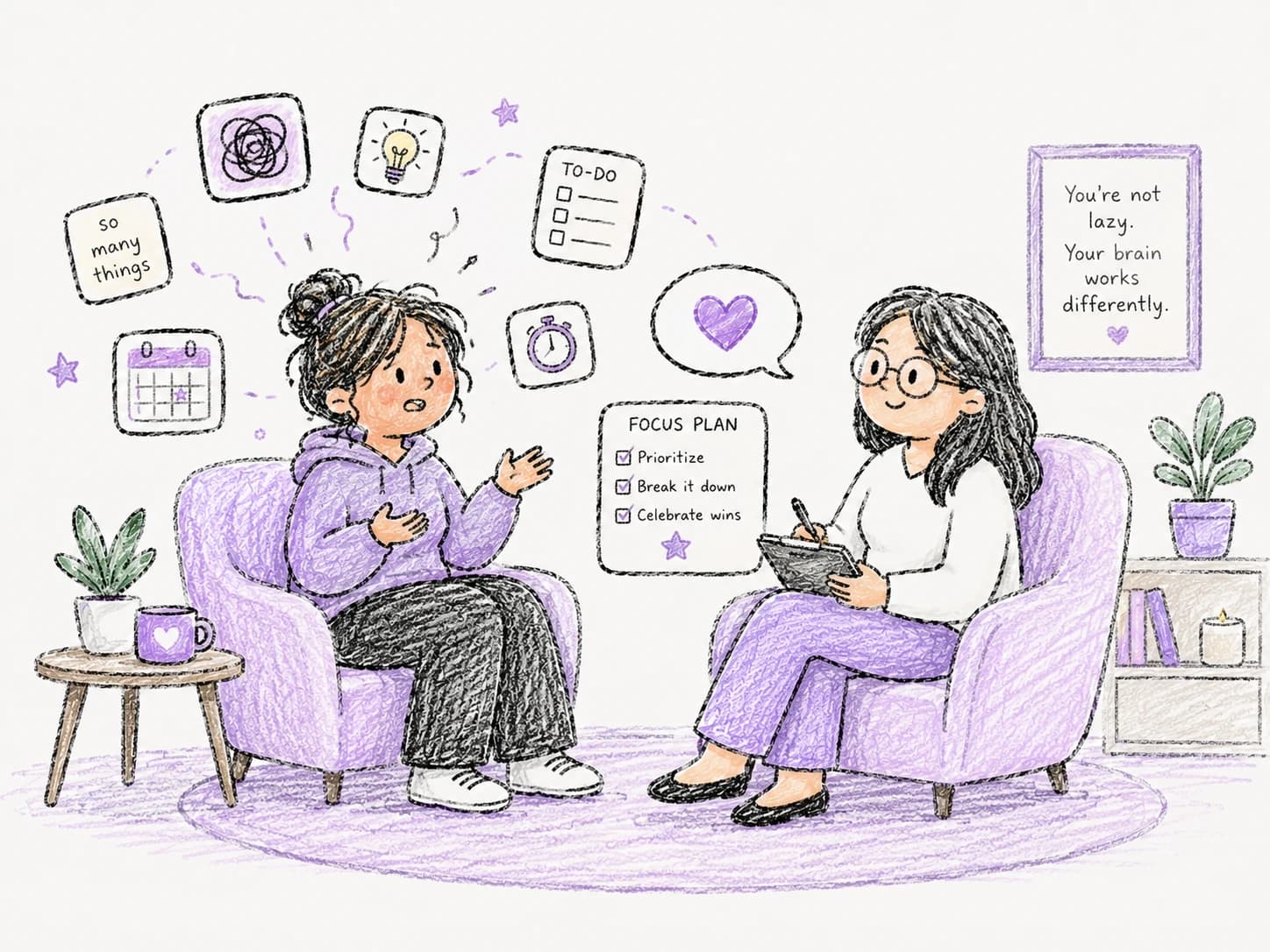
ADHD Therapists in Canada
Therapy for ADHD helps adults and teens understand how their brain works, build practical strategies for daily functioning, and address the anxiety, shame, or relationship difficulties that often develop alongside it.
What to look for in an ADHD therapist on Purple Lotus
- Experience working with ADHD in adults or the relevant age group
- Practical, skills-focused approach alongside emotional support
- Familiarity with ADHD and co-occurring anxiety or depression
- Willingness to collaborate with prescribing clinicians if medication is involved
20 therapists for ADHD in Canada
Browse 20 therapists specializing in ADHD. Find the right counsellor or psychotherapist for your needs.

Maitri Gupta
Starting therapy is daunting. Existing in this world is not easy! There is much uncertainty and hurt. I congratulate you for taking the initial steps to find the right fit for you. I believe that everyone has the right to healing and community. We heal in community. The work I do with my clients in essence is relational. The work you will do in therapy is a radical act of self-advocacy in a world that often demands from us productivity and perfectionism. As a social justice activist, yogi, and post-modernist my approach to healing work is holistic. I aspire to go beyond the medical model and do not conform to what the norm demands from us. As your therapist, I engage with you curiously to go deeper, exploring many aspects as you unpack the layers of your narratives. Healing can only begin when we separate who we are from our problems. Coming from a bi-cultural background, I believe the narratives we have to speak to our individualistic and collective experience of events. It is vital to look within and around the communities to which we belong. I can provide services in Hindi, Punjabi, and English. My goal as a therapist is to facilitate mindful exploration of your trauma in a safe, collaborative, and open space. I want to hear your stories. Revisiting painful, challenging, and stressful stories can be a complex process. You are not alone! We work at your pace to restore your agency so that you can reclaim the narratives that serve your interpersonal growth and well-being. Through a trauma-informed lens, together, we can unpack: Anxiety and Low Moods Addictions Abuse Sexuality Social Anxiety Self-esteem and self-worth Burnout Challenges around social justice advocacy and activism Fear and hopelessness Body Image Self-Care Chronic Illness Ableism Navigating bi-cultural reality and expectations Relationships Perfectionism ADHD Feelings of isolation My approach is multi-faceted, and I will be combining traditional talk therapy with somatic psychology practices. I believe movement is essential for our healing and self-regulation. With virtual sessions, I want us to acknowledge that we are present with each other in our whole bodies and not just our floating heads. Therefore, I invite you to get in touch with your senses and body through practices such as tapping exercises or body scans. I will also lean on my mindfulness philosophy to help guide a process through which you can access inner wisdom, be present in the here and now, to release your traumas, and narratives which no longer serve you. My mental health work background is grounded in traditional Vedic-Yoga practices, Buddhist psychology, and Western psychology. Over the last decade, I have strived to do collective healing work through my activism and mental health aid for community members. I am committed to supporting you on your healing journey with great compassion. At this time, I can only see clients that are currently residing in Canada. I wish to express gratitude, and acknowledgment that I currently live, work and play in the ancestral, traditional and unceded territory of the xʷməθkwəy̓əm (Musqueam), Skwxwú7mesh (Squamish), and Tsleil-waututh Nations.

Olena Guseva
Welcome! My aim as your therapist is to create a comfortable, judgment-free space where you can talk about whatever’s on your mind. We’ll work through the ups and downs together, celebrate the wins, and make sense of the moments that leave you wondering. So take a breath, settle in, and let’s start this journey toward healing together. Life changes have been a big part of my own experience, from moving countries to becoming a parent, so I get how messy and emotional transitions can be. Everyone’s story is unique, and I’m here to listen and really understand yours. I take a holistic view in therapy, looking at the mind, body, and spirit as all connected. My goal is to make this a safe and welcoming space for you to explore your thoughts and feelings, no pressure or judgment attached.

Chris Ho
If you find yourself navigating through the complexities of life, know that seeking counselling is a courageous and empowering choice. People seek counselling for a myriad of reasons, each journey as unique as the individual taking the first step. You might be facing the pressure of anxiety, the shadows of depression, or the echoes of past traumas. Life's challenges can be multifaceted, stemming from personal relationships, work-related stress, existential questioning, or unforeseen transitions. As a couple, you may be experiencing the severance of disconnection, rupture of infidelity, or the growing pains of change. I combine a tapestry of approaches to support you on your transformative journey. Mindfulness techniques provide a grounding anchor to the present, while Adlerian therapy delves into understanding the influence of your past on your current self. For couples therapy, I incorporate the Gottman method and Emotionally Focused Therapy to rebuild your foundations. Culturally sensitive and trauma-informed, my practice is a safe haven for individuals of all backgrounds and identities. No matter what brings you to therapy, we can cultivate resilience, uncover your inner wisdom, and empower you to live authentically and aligned with your values. With warmth, I am looking forward to connecting with you.

Nicole Neufeld
Hi, I'm Nicole (she/they). You might wonder what therapy can offer you, and that is a fair question. I used to ask the same thing and I remember my first therapy session as a client, I was so nervous I got in a car accident on my way to the appointment. Being vulnerable and sharing a piece of yourself can be so intimidating. It makes sense to feel nervous. Reaching out for support is challenging, and can also be empowering, I commend you for considering it. I am committed to providing as safe a space as is possible to those who would choose to trust me with their story. Part of that includes an understanding of how systemic power and inequity impacts us all. I navigate the world as a white, settler woman. I also have lived experience with chronic illness, and a late-in-life ADHD diagnosis. These, among other pieces of my identity, impact my lived experiences of the world as your identity impacts yours. Because of this, I use an intersectional, systemic approach in my work, leaning on Feminist Theory and utilize AEDP (Accelerated Experiential Dynamic Psychotherapy) and Narrative techniques. I believe you have resources and answers within yourself, and I am honoured to support you as you discover and grow in your own strength. I take a collaborative approach, meaning you get to play an active role in deciding how our time together is spent. Ultimately, I am committed to your healing and will use all of the tools at my disposal to support you on your journey. My hope for you is that you flourish in your life, and are able to feel all of the joy and delight that comes from that.

Tarni Kaur
You’ve learned to hold it all together; for family, for culture, for survival. You’re insightful, but tired. Maybe it’s anxiety, burnout, people-pleasing, or the quiet weight of not feeling fully seen. You want space to exhale and to feel understood. My clients seek clarity, regulation, and belonging. Together, we’ll explore the patterns you’ve inherited, the ones you’re ready to let go of, and the parts of you waiting to feel at home. I offer culturally responsive, neurodivergent-affirming therapy with a deep understanding of identity, belonging, and the impact of cultural and family systems on emotional well-being. My approach is integrative and person-centered, drawing from ACT, IFS, CBT, and mindfulness to support emotional regulation, self-trust, and meaningful change. Starting therapy is vulnerable, especially if you're used to managing on your own. You don’t have to carry everything alone. If you’re feeling overwhelmed, disconnected, or unsure of where to begin, I’m here to support you. Let’s work together to explore what healing, safety, and alignment might look like for you.

Fiona Del Rio
I support individuals navigating a wide range of challenges, including anxiety, depression, ADHD, stress, grief, trauma, life transitions, and relationship concerns. No matter what brings you to therapy, I aim to help you deepen self-awareness and develop practical strategies that help build resilience and promote healing. As a therapist, my approach is rooted in compassion, collaboration, and a deep respect for your lived experience. I offer client-centered care that draws from strengths-based and trauma-informed modalities, working with you to build a therapy plan that reflects your values, goals, and vision of wellness. My priority is to foster a space where you feel safe, seen, and empowered to be your authentic self. My educational background includes a Masters in Counselling Psychology, Masters in Anthropology, and Bachelors in Psychology and Cinema. I possess additional training in several evidence-based and trauma-focused therapeutic modalities. Together, we will design an approach that is tailored to your unique needs and preferences, and one that delivers meaningful results. I worked in public, private, and creative sectors before transitioning to counselling, where I gained experience as a crisis responder and in employment and career advising. My diverse professional experiences along with my own mental wellness journey help me to provide well-rounded support that is grounded in continuous self-reflection.

Ramona Saeedi
If you landed on this page, you took the first step. As humans we have the capacity to adapt and discover more meaning & joy in life as we face and overcome obstacles in life. To me, happiness is the process of solving problems and developing more adaptive ways of being. I am excited to help you overcome challenges and achieve your wellness goals. Hi, my name is Ramona and welcome to my page! As a therapist, I take you seriously. Not just what you say, but what you’re bringing with you. My clients often tell me they feel genuinely understood, because I notice the weight you’re carrying, the patterns you’ve been sitting with, and the parts of your story that actually matter. I’m curious about who you are in the context of everything that shaped you: your culture, your relationships, your upbringing. I connect those threads with what’s happening with you now. I see individuals and couples across a wide range of experiences: mood disorders like depression and anxiety, identity work, ADHD, grief, and trauma. I’m equally comfortable supporting someone navigating a single difficult season or working through patterns that have persisted for years. I have particular experience with adolescents and young adults, as well as adults in midlife transitions. Whether you’re coming in with a specific crisis or just a sense that something needs to shift, I meet you where you are. Over my 10+ years as a therapist, I’ve developed an integrative approach. I draw on CBT, DBT, Solution-Focused therapy, Narrative therapy, and EFT for couples. For trauma, I use EMDR, inner child work, and attachment-based approaches. I trained in nervous system work and trauma-informed yoga in Indonesia. I understand how trauma lives in the body, not just the mind. More than the techniques, what ties them together is that I believe you already have the answers within you. My job is to create the conditions where those answers surface. Real trust and empathy. The safety to explore. The space to discover what change actually looks like for you. I’m a member of the College of Registered Psychotherapists of Ontario (CRPO) and specialize in relational therapy. I work from a multicultural, anti-oppressive perspective, which means I’m attuned to the systems and contexts that shape your experience. With me, you get access to therapy from the comfort of your space!

Mary Hugessen
Hi, I’m Mary — a Registered Social Worker with nearly a decade of experience supporting individuals with developmental disabilities and mental health challenges. I specialize in working with neurodivergent folks who are navigating life’s complexities and looking for a path forward that truly fits them. My approach to therapy is eclectic and person-centered — meaning we’ll work together to identify what matters most to you and explore the steps that feel right for where you’re at. Whether you're seeking support with daily stressors, big transitions, or simply need a space where you can be your full self, I'm here to walk alongside you with compassion, curiosity, and care.

Jessica Charles
I specialize in helping young adults with CPTSD symptoms like low self-worth, depression, substance misuse, and neglect. Honestly – everybody needs to be empathetically challenged. To see if we’re a fit, email me for a free 15-min consultation :).

Nathan Walton
I am currently completing my clinical residency at Yorkville University via True Self Counselling. I practice under supervision of a highly experienced therapist, and am scheduled to graduate in May 2026. I specialize in working with people who feel wired differently - highly sensitive, gifted, neurodiverse, or twice/thrice exceptional. You may see the world in ways others can’t, yet find yourself overwhelmed by sensory overload in a world that’s too loud. Therapy can help you honour your unique wiring, manage challenges, and create a life that truly fits.

Marc-Anthony Racco
Are you struggling to maintain relationships? Maybe you feel disconnected, unable to get through the day without negative thought patterns. As a psychotherapist, I work with both teens and adults, specializing in relational and childhood trauma. However, I also work with individuals who have faced various life challenges, such as anxiety, depression, and attachment difficulties. Holding a queer identity and a crisis counselling background, my therapeutic space is highlighted in inclusivity, incorporating anti-oppressive and strength-based frameworks to create a safe, non-judgmental space for you to express your thoughts freely. My sessions often take a client-centred approach, building a collaborative process of unlearning damaging self-beliefs, practicing healthy coping skills, and reclaiming your life through newly formed self-awareness. This is your journey, and I will work closely with you to develop a treatment plan specific to your unique needs and goals. I view trauma as a relational experience. Not only is it often experienced in relationships with others, but it is also a new development of healthy relationships that can assist in healing.

Chinwendum Onyeocha
I help clients explore why their mind functions the way it does, especially when they feel stuck in patterns of overthinking, anxiety, low self-esteem, relationship challenges, ADHD-related difficulties, or emotional overwhelm. My approach is warm, collaborative, and grounded in curiosity, helping clients better understand their thoughts, emotions, and behaviours while developing practical tools for change. When working with me, clients can expect a safe, non-judgmental space where we move at a pace that feels supportive. Together, we will work toward greater clarity, emotional awareness, self-compassion, and confidence in how you navigate your life.

Sally Ibrahim
If you’re finding it hard to connect with others, feeling stuck in painful relationship patterns, or overwhelmed by anxiety, stress, or sadness, you’re not alone. Many of the struggles we face are not flaws or signs of failure. They are often adaptations to past experiences where emotional needs, like being comforted, feeling safe, accepted, or truly heard, weren’t fully met. I work with adults navigating relationship challenges, low mood, overthinking, uncertainty about themselves, or difficulties with focus and restlessness. These experiences can be influenced by many factors, such as ADHD, burnout, identity-related stress, or difficult past experiences. You might notice patterns like shutting down, feeling easily overwhelmed, or being misunderstood in your closest relationships. These are often protective responses that once helped you cope, but are now getting in the way of the life and relationships you want. My approach is grounded in a trauma-informed lens and an understanding that mental health is shaped by many layers—our biology, environment, culture, and early relationships. I also pay close attention to how the nervous system responds to stress and safety, helping you make sense of your emotional reactions with more compassion and less shame. Clients often share that they feel relieved when their struggles finally start to make sense. I walk alongside you with warmth and respect as we explore your experiences with curiosity, not judgment. My hope is to help you reconnect with parts of yourself that feel lost, hurt, or misunderstood. Together, we’ll build healthier emotional responses, uncover strengths buried beneath survival patterns, and move toward a life and relationships that feel more secure, fulfilling, and aligned with who you are.

Megan Hill
I offer a space where you don’t have to figure it all out on your own. I invite all parts of you forward, taking a calm, intuitive, and reflective approach to help you understand where these patterns come from and reconnect with the parts of you that need care. Together, we will work toward greater balance, confidence, and emotional ease in your everyday life.

Jeff O'Neill
Understanding ADHD If you're reading this, there's a good chance you're exhausted. Not the kind of tired sleep fixes — the kind that comes from spending years fighting your own brain and losing more often than you'd like to admit. Maybe you have a diagnosis. Maybe you've suspected it for a decade and never had it confirmed. Maybe you're a woman who was told it was anxiety, or depression, or that you were "too sensitive," and ADHD never even came up until recently. Whatever your path here, I'd guess you're tired of half-working strategies, tired of starting over, and tired of feeling like everyone else got a manual you never received. Let me say this plainly: ADHD is genuinely frustrating to live with. Not "quirky," not "just a different way of thinking" in some tidy, inspirational sense — frustrating, in the day-to-day, why-can't-I-just-do-the-thing way. That frustration is real, and it deserves to be named instead of smoothed over. You are not lazy. You are not broken. You are not failing at things that come easily to everyone else — you're doing hard things with a brain that runs on a different operating system, often without the support that operating system actually needs. How I Can Help I hold an MA in Counselling Psychology, and I'm also an ADHD Certified Clinical Services Provider (ADHD-CCSP) and Clinical Coach — which means I work at the intersection of two things people with ADHD usually have to go find separately: real emotional support, and real skills training. The counselling side is where we deal with the parts that therapy is built for — the shame that's built up over years of masking, the identity questions that come with a late or self-identified diagnosis, the impact on relationships and self-worth, the emotional weight of just being an ADHD brain in a world that wasn't built for it. The coaching side is where we get practical. Insight alone doesn't get the laundry done or the report finished. As an executive function coach, I help build the actual scaffolding — systems for follow-through, structures that survive contact with a bad week, and My Approach Most people I work with already know what they want to do. The gap isn't motivation — it's the space between knowing and doing, and that gap is often more emotional than it looks. Rejection sensitive dysphoria (RSD) — that sharp, disproportionate sting of criticism or perceived failure — is one of the biggest hidden drivers of ADHD struggles, quietly shaping careers, relationships, and self-worth long before anyone connects it back to ADHD. I draw on CBT, DBT, and ADHD-informed coaching to work both angles at once — the emotional regulation and distress tolerance side, and the concrete executive-function side. DBT skills in particular map unusually well onto ADHD life. Sessions are structured, but they flex: there's no judgment for showing up late, needing to move around, or not having a formal diagnosis in hand. What We Can Work On RSD and emotional regulation — the sharp sting of perceived criticism and the mood shifts that come with it Executive dysfunction and procrastination — not a willpower problem, a wiring problem, and one we can actually build around ADHD burnout — the specific exhaustion of running on compensation and masking for too long Self-suspected or undiagnosed ADHD — you don't need a formal assessment to start making sense of your own brain ADHD in women — masking, late diagnosis, and the hormonal impact that most ADHD resources still leave out Perfectionism and shame — especially the kind that's been quietly accumulating since childhood Communication and relationship struggles — the ADHD patterns that show up with partners, friends, and family Workplace challenges — deadlines, follow-through, and functioning in systems that weren't built for your brain Major life transitions Additional Areas of Expertise While ADHD is my primary specialty, I also work with clients navigating addiction, anger management, and men's mental health issues. Addiction: I help clients understand the patterns behind their challenging behaviors. Whether it be substances, pornography, gambling, or social media—I can help develop healthier coping strategies to build sustainable recovery. I also support caregivers, partners, and family members affected by a loved one's addiction, working through boundary-setting, managing worry and frustration, and taking care of your own wellbeing while supporting someone you care about. Anger Management: We explore what's beneath the anger—frustration, shame, or feeling unheard—and develop tools for emotional regulation and communication that actually work in real life. Men's Issues: I create judgment-free space for men to explore emotions, relationship challenges, identity, and personal growth. Whether you're dealing with stress, transitions, or feeling stuck, we'll work through it together. Across all areas, my approach remains practical, collaborative, and grounded in compassion.

Tori Lewis
Hello and welcome. I’m Tori, a Registered Social Worker and therapist who provides a compassionate and collaborative space for healing and growth. Many of the people I work with feel overwhelmed, misunderstood, or like they have spent much of their lives trying to adapt themselves to fit expectations around them. You may be navigating ADHD, autism or other neurodivergent experiences, processing trauma, coping with anxiety or depression, experiencing relationship challenges, or moving through difficult life transitions. Sometimes people come to therapy feeling exhausted from carrying so much on their own and unsure where to begin. My approach is trauma-informed, relational, and client-centered. I draw from a variety of therapeutic approaches including CBT, mindfulness-based strategies, attachment-informed perspectives, and other integrative tools to support your unique needs. Rather than taking a one-size-fits-all approach, I believe therapy should feel collaborative. We work together to understand your experiences, identify meaningful goals, and develop tools that feel realistic and authentic for you. I strive to create a space where you can show up exactly as you are without judgment or pressure to have everything figured out. Healing is not always linear, and therapy is not about fixing who you are. It is about building understanding, self-compassion, resilience, and creating meaningful change at your own pace. I offer virtual counselling sessions across Ontario and would be happy to connect through a complimentary consultation to see whether we may be a good fit.

Christian Kleiser
Hello! My name is Christian, and I am a Registered Psychotherapist (Qualifying) at Black Onyx Counselling and Wellness. I hold a Master of Arts in Counselling Psychology from Yorkville University, and Honours degrees in both Kinesiology and Psychology, Neuroscience and Behaviour from McMaster University. My Approach to Therapy: DBT – Dialectical Behavioural Therapy (DBT) provides practical skills and techniques to support emotional regulation, distress tolerance, interpersonal skills, and mindfulness. DBT skills will help you balance acceptance and change. CBT – Cognitive Behavioural Therapy (CBT) explores the patterns in our thoughts, feelings, and behaviours to reshape how we engage with the world. A healthier outlook will help create positive and lasting change. Collaborative and Integrative - Healing requires an understanding of the challenge and an intentional approach. Together, we will integrate evidence-based interventions with your life experience to tailor our work to meet your needs and goals. Who I Work With: Individuals, Couples, and Families Adults, Children, and Older Adults Areas of Focus Neurodivergence, Time Management, and Goal Setting Emotional Dysregulation and Mindfulness Anxiety and Depression Trauma and Stress Healthy Communication and Boundary Setting Loneliness and Self-Worth Grief and Life Transitions Addictions I offer in-person sessions in London and virtual sessions across Ontario. I invite you to book a free 20-minute consultation today to explore whether working together feels like the right fit for you. I believe therapy is a journey towards healing and self-discovery, and I welcome the opportunity to help you move forward with clarity and confidence.

Monika Mehan
In my journey as, first, a therapy client, and then a psychotherapist, one of the most striking things I've learned has been that we tend to hold deep knowledge about what we actually want, need, and feel. That the signals our bodies and brains deliver to us aren't random. The anger that we might try to push down can actually tell us where a boundary of ours - one we might not have even recognized for ourselves yet - is being crossed. The tiredness or pain in our bodies might be telling us to slow down, to pay attention to an important part of ourselves, an important feeling, that we've tried to ignore out of fear. When we have a hard time getting moving on a project, it isn't a character flaw - it's giving us important information about a need we have, perhaps around relaxing our own expectations for ourselves, or getting more clarity around what we're trying to do. It makes sense that we don't always listen to these inner signals of ours, for so many reasons. In today's world, many of us are busy just trying to survive, and might feel like turning inward is unhelpful or a waste of time. We might fear that we'll discover a part of ourselves that's asking for a change that we don't yet feel ready to implement in our lives. We might have learned throughout our lives that our feelings are too big or threatening to handle, so ignoring them becomes the default. I believe, however, that if we're able to receive support in slowing down and listening to that inner voice, we can start to truly move toward an easier, more aligned, more fulfilling life, with more fulfilling connections - with others and with ourselves. I love to support folks moving through this type of work. I often work with clients who might be feeling stuck, unhappy, isolated, or overwhelmed. I also see many clients who are neurodiverse, and hold lived experience with AuDHD myself. I love working with creative people, people who have self-identified as "people pleasers," anyone experiencing relationship difficulties or life transitions - whatever it is you're going through currently, and whoever you are, I'd love to chat about it! I am a graduate of the Toronto Institute of Relational Psychotherapy and am trained as a relational therapist, which means that I think about the rules we learn implicitly in our lives about relationships - who were we taught that we need to be in order to stay in connection with others? These often-invisible-to-us rules deeply impact how we relate to those around us, but also how we relate to ourselves, and to what degree we're able to listen to that aforementioned inner voice. If we learned our needs were too big and the people around us needed them to be smaller - we'll ignore anything inside of us that's trying to alert us to a need we have. If we learned we had to constantly fight for ourselves, we might have a harder time listening to an inner voice of ours that's asking for some softness. I would love to support you in letting all of the complex pieces of yourself have space to share and room to shine. If my profile resonates with you, please don't hesitate to reach out - I would love to hear from you, and to have the chance to chat about how we can work together! :)

Julianna Servello
I work with children, teens, adults, couples, and families who may be feeling overwhelmed, stuck, disconnected, or unsure of how to move forward. My goal is to create a warm, supportive space where you can feel comfortable being yourself while working toward meaningful and lasting change. I bring a strong clinical background to my private practice, with experience working in hospital and community settings with individuals and families navigating a wide range of mental health, emotional, relational, and life challenges. My hospital experience has given me the opportunity to work with people during some of the most difficult and uncertain periods of their lives, supporting clients and families through complex circumstances, significant transitions, illness, trauma, crisis, grief, and changes in functioning. This experience has shaped the way I practice today: with compassion, clinical thoughtfulness, and an understanding that every person’s circumstances and needs are different. My clinical work includes supporting individuals experiencing anxiety, ADHD, OCD, emotional regulation difficulties, relationship and family concerns, grief, trauma, burnout, self-esteem concerns, and major life transitions. I also support clients through prenatal and postpartum challenges and the emotional impact of motor vehicle accidents and other traumatic experiences. I work with clients across the lifespan and tailor therapy to their individual goals, strengths, personality, and circumstances. OCD is a particular area of clinical interest and expertise for me. I have extensive training and experience supporting clients with OCD and related anxiety concerns, and I understand how consuming and disruptive intrusive thoughts, uncertainty, compulsions, and avoidance can become. My approach is compassionate, collaborative, and evidence-informed, with the goal of helping clients better understand their experiences and develop greater confidence in responding to difficult thoughts, feelings, and sensations. I also provide OCD-focused clinical supervision and consultation to other clinicians looking to strengthen their knowledge and confidence in this area. I also have a strong interest in ADHD and emotional regulation. For clients with ADHD, I recognize that challenges can extend far beyond attention and organization and may affect relationships, self-esteem, emotional regulation, work, school, and day-to-day functioning. Therapy can provide a space to better understand these patterns, develop strategies that are realistic for your life, and move away from shame or self-criticism toward greater self-understanding. My approach is integrative and individualized. I draw from Cognitive Behavioural Therapy (CBT), Dialectical Behaviour Therapy (DBT), Acceptance and Commitment Therapy (ACT), trauma-informed practice, narrative therapy, and strengths-based approaches. Rather than using a one-size-fits-all model, I consider what you are experiencing, what has or has not worked for you in the past, and what you hope to change. Together, we can identify practical strategies while also exploring the deeper patterns, experiences, and relationships that may be contributing to what you are experiencing. I believe therapy should be both clinically meaningful and genuinely human. You do not need to have everything figured out before coming to therapy, and you do not need to know exactly what you need. Sometimes people simply know that something is not feeling right, that they are exhausted from trying to manage everything on their own, or that they keep finding themselves caught in the same patterns. Therapy can provide an opportunity to slow down, make sense of what is happening, and develop a clearer path forward. Whether you are navigating anxiety, OCD, ADHD, grief, trauma, relationship difficulties, burnout, a major life transition, or simply feeling stuck, I aim to meet you where you are. My role is not to tell you who you should be or how you should live, but to work alongside you to better understand yourself, build on your existing strengths, and develop meaningful changes that fit your life. I welcome the opportunity to work collaboratively with clients and, when appropriate, with families and other healthcare professionals involved in their care. My hospital background has reinforced for me the value of collaboration and continuity of care, and I believe that connecting clients with the right supports can make an important difference in their overall wellbeing. Above all, I want therapy to feel like a space where you can be honest, understood, and supported without judgment. Whether you are coming to therapy for the first time or have been in therapy before, we can start wherever you are and work together from there.
What is ADHD?
Attention-Deficit/Hyperactivity Disorder (ADHD) is a neurodevelopmental condition that affects attention regulation, impulse control, and executive functioning. It is not a matter of trying harder or caring more. People with ADHD often have significant capacity and intelligence but face real and consistent challenges in areas like organizing tasks, managing time, sustaining focus on lower-stimulation work, and regulating emotions. These difficulties can affect work performance, relationships, finances, and self-esteem, particularly for those who spent years not understanding why things that seemed easy for others felt so much harder for them.
Many adults seek therapy after a late diagnosis, following years of frustration, underachievement, or coping strategies that worked inconsistently. Therapy can help you understand how ADHD affects your specific functioning, develop practical tools tailored to how your brain works, and address the emotional patterns that often accumulate alongside it, such as anxiety, perfectionism, chronic self-criticism, or avoidance.
ADHD therapy is not one fixed approach. Therapists who work well with ADHD tend to draw on cognitive behavioral therapy (CBT) adapted for executive functioning challenges, dialectical behavior therapy (DBT) skills, mindfulness-based strategies, and psychoeducation. Sessions are often practical and skills-focused, though many people also benefit from exploring the emotional and relational dimensions of living with ADHD over time. Medication is commonly used alongside therapy and is a separate decision made with a prescribing clinician.
Who this approach may help
Adults with a recent ADHD diagnosis
People who received an ADHD diagnosis in adulthood and are working to understand its impact on their life, relationships, and career, often while processing years of unexplained difficulty.
Difficulty with executive functioning
People who consistently struggle with task initiation, prioritization, time management, or following through on plans, even when motivation and intention are present.
Emotional dysregulation
People who experience intense emotional reactions, rejection sensitivity, or difficulty returning to baseline after frustration or disappointment, which are common but often overlooked aspects of ADHD.
ADHD alongside anxiety or depression
People managing anxiety or low mood that developed partly in response to years of ADHD-related struggles, including chronic self-doubt, burnout, or repeated experiences of falling short of their own expectations.
Teens and young adults navigating transitions
Young people managing ADHD through school, post-secondary, or early career, where the demands on self-management increase and previous support structures may no longer be in place.
Relationship and communication difficulties
People whose ADHD affects their relationships, including patterns of forgetting commitments, difficulty sustaining conversations, impulsivity in conflict, or partners frustrated by perceived inconsistency.
What happens in a session?
- 1
Map how ADHD shows up for you
The therapist helps you identify which areas of functioning are most affected, what your current coping strategies look like, and where the biggest impact on your daily life is.
- 2
Build understanding of the underlying patterns
You learn how ADHD affects attention, memory, emotion regulation, and motivation, replacing shame-based explanations with a clearer picture of what is actually happening.
- 3
Develop practical strategies
Together you work on specific tools for planning, task management, transitions, or whatever area is most relevant, adapting strategies to fit how your brain actually responds rather than how it is supposed to respond.
- 4
Address emotional patterns
Sessions explore how years of ADHD-related difficulty may have shaped beliefs about yourself, including perfectionism, avoidance of tasks linked to past failure, or patterns of giving up before trying.
- 5
Adjust and build on what works
The therapist tracks what strategies are helping and refines the approach over time, since ADHD presentation and what works can vary between life domains and life stages.
How it compares to other approaches
ADHD Coaching
ADHD coaching focuses on accountability, goal-setting, and practical skill development. It does not address mental health conditions or underlying emotional patterns. Therapy covers those dimensions and is delivered by a licensed clinician, which may be relevant for insurance coverage or when anxiety, depression, or trauma are also present.
Cognitive Behavioral Therapy (CBT)
Standard CBT targets thought patterns and behaviors. CBT adapted for ADHD specifically addresses executive functioning deficits, avoidance behaviors related to low-stimulation tasks, and the negative self-beliefs that often develop over time. Some therapists use the term CBT but may not be trained in the ADHD-specific adaptations.
Dialectical Behavior Therapy (DBT)
DBT skills, particularly emotional regulation and distress tolerance, are often useful for people with ADHD who struggle with intense emotions. DBT was not developed specifically for ADHD, but many ADHD therapists draw on its skill modules.
Medication Management
Stimulant and non-stimulant medications for ADHD are prescribed and monitored by physicians or psychiatrists, not therapists. Medication and therapy address different aspects of ADHD and are often used together. A therapist can help you understand and work with your experience of medication without prescribing or advising on it.
Psychoeducation
Psychoeducation about ADHD, through books, courses, or groups, can be valuable. Therapy goes further by applying that understanding to your specific situation, addressing personal history, and working through the emotional dimensions that general education does not cover.
How to choose an ADHD therapist
Questions to ask before booking:
- 1
Ask whether they have specific experience working with ADHD in adults or teens. General mental health experience is not the same as familiarity with how ADHD presents and how to adapt the therapeutic approach accordingly.
- 2
Ask what their approach looks like in practice. Effective ADHD therapy tends to be more active, practical, and structured than traditional talk therapy. If a therapist offers only open-ended exploration, that may not be the most effective fit for ADHD.
- 3
Ask whether they address emotional regulation and self-esteem alongside practical skill-building. ADHD therapy is most useful when it covers both functional strategies and the emotional patterns that have built up around them.
- 4
Ask about their experience with ADHD when it co-occurs with anxiety, depression, or trauma, since those combinations are common and affect how therapy should be sequenced.
- 5
Ask how they involve medication in the conversation if you are taking or considering ADHD medication. A good therapist does not need to be a prescriber but should be able to coordinate with your prescribing clinician when helpful.
- 6
Ask what progress looks like and how they measure it. Because ADHD affects many domains, knowing which areas will be prioritized first and how you will know if the work is helping can make the process feel more manageable.
When this may not be the right fit
If you have not yet been assessed for ADHD, therapy can still address many of the functional and emotional difficulties you are experiencing, but a formal assessment may provide clarity that makes the work more targeted. A therapist can discuss whether an assessment would be useful in your situation.
If you are in acute crisis or dealing with a psychiatric emergency, stabilization and safety planning take priority. ADHD-focused therapy is most effective when basic functioning is supported.
If your primary goal is accountability and productivity coaching without a mental health component, an ADHD coach may be a more direct fit, particularly if you are not experiencing significant anxiety, depression, or emotional dysregulation.
ADHD is sometimes confused with other conditions, including anxiety disorders, mood conditions, trauma responses, or sleep disorders, that can produce similar-looking symptoms. If your difficulties have not been properly assessed, therapy alone may address symptoms without identifying the full picture.
Related specialties
Frequently asked questions
Can therapy help with ADHD?
Yes. Therapy does not change the underlying neurobiology of ADHD, but it can help you develop practical strategies, understand your patterns, and address the anxiety, shame, or self-doubt that often accumulate alongside it. Many people find therapy most helpful when used alongside medication and other supports.
What kind of therapy is most effective for ADHD?
Cognitive behavioral therapy adapted for ADHD has the strongest research support for adults. DBT skills, mindfulness-based approaches, and psychoeducation are also commonly used. The right approach depends on which aspects of ADHD affect you most and whether other conditions like anxiety or depression are also present.
Do I need a diagnosis to see a therapist for ADHD?
No. Many therapists will work with people experiencing ADHD-related difficulties regardless of whether a formal diagnosis exists. That said, a diagnosis can clarify what you are working with and may be required for certain supports like workplace accommodations or medication.
How is ADHD therapy different from ADHD coaching?
Coaching focuses on accountability, productivity, and practical skill development. Therapy is delivered by a licensed clinician and also addresses mental health conditions, emotional patterns, and personal history. If anxiety, depression, or past trauma are part of the picture, therapy is typically the more appropriate starting point.
How long does therapy for ADHD take?
It depends on your goals and what you are working on. Some people do shorter, structured work focused on specific functional strategies. Others benefit from longer-term support that addresses the emotional dimensions of living with ADHD over many years. Your therapist can help you set realistic expectations based on your situation.
Can I do ADHD therapy online?
Yes. Online therapy works well for ADHD, and some people find it easier to fit into their schedule than in-person sessions. Therapists who work with ADHD online are often familiar with adjusting session structure to account for attention and focus. Check each therapist profile for available formats.
Looking for an ADHD therapist?
Browse therapists in Canada who specialize in adhd. Filter by location, fee, and session format to find the right fit.