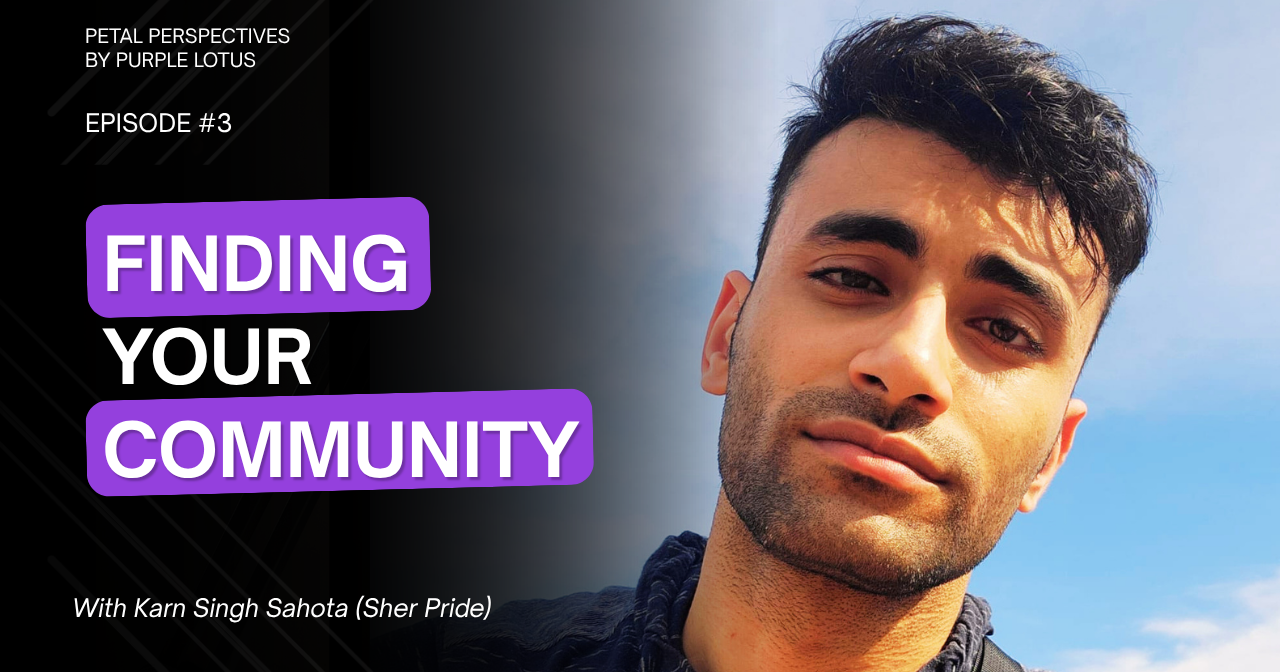
What does it actually take to build a sense of belonging in spaces that were never designed with you in mind?
In this episode of the Purple Lotus Mental Health Podcast, we sit down with Karn S. Sahota (he/him), Outreach and Volunteer Manager at Sher Pride, to talk about queer South Asian identity, community, belonging, and what it really means to find connection in spaces that were never built for you.
Karn's work centers on strengthening community connections and creating safer, more inclusive spaces through volunteer engagement and outreach. He shares his perspective on the gaps that exist in mainstream support systems, why Sher Pride exists, and what it takes to build genuine belonging for queer South Asian communities.
This conversation is honest, grounded in lived experience, and full of insight for anyone who has ever searched for a space where they truly belong.
Queer South Asian Identity Beyond Stereotypes
Queer South Asian identity is often flattened into a single narrative, one shaped by assumptions about culture, family, and religion rather than lived reality. Karn pushes back on that flattening, speaking to the range of experiences within the community that rarely get airtime.
Rather than a fixed set of struggles, Karn frames identity as something that shifts depending on context such as family, faith, culture, and chosen community all pulling in different directions at different times.
What Allies and Helping Professionals Often Miss
Even well-intentioned allies, therapists, and helping professionals can miss the specific texture of queer South Asian experience if they approach it through a general LGBTQ+ lens or a general South Asian lens alone. Karn points to a few recurring blind spots:
- Assuming family rejection looks the same across every culture
- Treating queerness and cultural identity as separate, competing parts of a person instead of something lived together
- Underestimating how much unlearning is required before someone can truly hold space for this kind of dual identity
- Assuming "coming out" is a universal framework that applies the same way in every family or culture
Karn speaks to what it actually takes — for professionals and allies alike — to unlearn these assumptions and show up in a way that reflects the real complexity of someone's identity, rather than a simplified version of it.
Community and Therapy Are Not the Same Thing and Both Matter
One of the clearest points in this conversation is the distinction between community and therapy. They serve different purposes, and neither can fully replace the other.
Therapy offers a structured, individual space for processing and healing. Community offers something therapy alone often can't: shared lived experience, visibility, and the simple relief of being around people who don't require an explanation.
Karn's work at Sher Pride sits squarely in that second space. Sher Pride is building the kind of community infrastructure that mainstream systems, including many therapy models, weren't originally designed to provide.
Why Loneliness Persists Even When We're Constantly Connected
Being surrounded by people, or constantly online, doesn't guarantee connection. Karn speaks to why loneliness can persist even in the presence of constant digital contact and what that loneliness might actually be signaling.
For many queer South Asian individuals, loneliness isn't just about a lack of people nearby. It can come from being in spaces like family, culture, even LGBTQ+ spaces where part of their identity still has to stay hidden or explained.
What Genuine Belonging Actually Feels Like
Belonging isn't static. Karn describes how it changes over time: starting, for many, as simple relief at being seen, and evolving into something steadier as trust builds:
- Belonging often starts with being seen without having to explain yourself
- It deepens through consistency, not a single moment of acceptance
- It can coexist with a complicated relationship to family or culture
- It looks different for every person, shaped by their own history and community
This is the core of Sher Pride's work. It is the ongoing work of creating spaces that queer South Asian people can return to, again and again.
Watch the Full Episode
Watch the full conversation with Karn S. Sahota on YouTube or listen on Spotify to hear more about queer South Asian identity, community, and what it takes to build genuine belonging.
Explore more conversations and mental health resources at Purple Lotus Mental Health.
About Purple Lotus Mental Health
Purple Lotus Mental Health is a Canadian mental health platform focused on making therapy and mental wellness resources more accessible. Through therapist directories, educational content, and conversations like these, Purple Lotus aims to create more open and supportive discussions around mental health.
Looking for a therapist who understands queer South Asian identity?
Find a Therapist
Written by
Cher Peng
Co-Founder, Marketing & Community Lead
Cher Peng (she/they) is a community-driven builder based in Vancouver who completed her studies at the University of British Columbia. She is the co-founder of Purple Lotus, a Canadian platform improving access to mental wellness care by helping people find the right therapist quickly and intuitively. Her work sits at the intersection of product, research, and community, with experience spanning UX innovation, venture development, and nonprofit leadership. Cher is driven by a commitment to building human-centered solutions that create meaningful, real-world impact.