
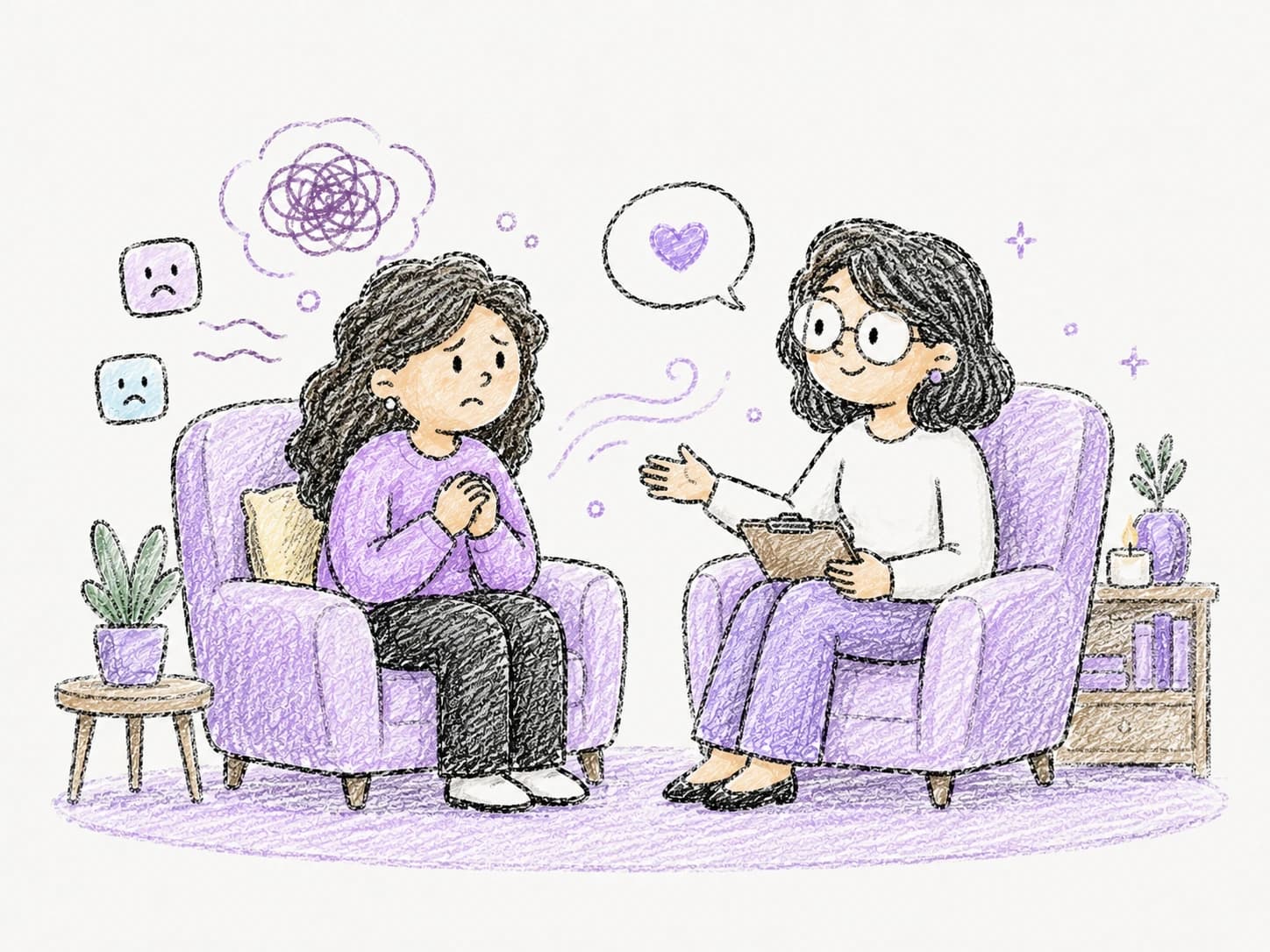
Relationship Issues Therapists in Canada
Support for people navigating conflict, communication difficulties, trust issues, and recurring patterns in their relationships with partners, family members, or close friends.
What to look for in a Relationship Issues therapist on Purple Lotus
- Training in relationship-focused approaches such as EFT, Gottman, or attachment-based therapy
- Experience with your specific concern, whether that is couples conflict, family dynamics, or recurring patterns
- Clarity about whether sessions are individual, couples, or both
- Comfort working with communication, conflict, and emotional vulnerability
30 therapists for Relationship Issues in Canada
Browse 30 therapists specializing in Relationship Issues. Find the right counsellor or psychotherapist for your needs.

Samantha Lee
Are you feeling overwhelmed by anxiety, stress, or struggling to balance different parts of yourself? Maybe you’ve felt misunderstood or like your needs aren’t being fully seen. You might also be dealing with relationship challenges or difficult emotions. Trying to meet the expectations of family, society, culture, work, and your own inner standards can add extra pressure. Holding multiple identities can make this even more complex. As a queer woman of colour, I can relate to how challenging this can be. I’m passionate about supporting LGBTQ+ and racialized individuals, as well as folks from all walks of life. Together, we’ll work to create a space where you can feel heard and supported as you navigate life’s challenges. Whether you’re seeking understanding, practical tools, or a safe space to process difficult emotions, we’ll go at your pace to find what feels most helpful for you. Life can be tough, but you don’t have to navigate it alone. If this resonates with you, let's connect for a free 15-minute consultation to see if we might be a good fit.

Jessica Charles
I specialize in helping young adults with CPTSD symptoms like low self-worth, depression, substance misuse, and neglect. Honestly – everybody needs to be empathetically challenged. To see if we’re a fit, email me for a free 15-min consultation :).

Lia Marks
Lia is a Registered Social Worker, Psychotherapist who supports individuals facing anxiety/depression, life transitions, parenting challenges, trauma and attachment difficulties. Whether you’re having trouble managing stress, understanding your emotions and behaviours, or want to develop coping skills, it is helpful to have a sounding board to support you. She provides a non-judgemental space to explore how your past experiences have influenced your current ways of coping. Through this process, she can assist you in developing new strategies to manage complex thoughts and feelings. Lia works from a trauma-informed, collaborative perspective to help you make the changes you want to make in your life

Melanie Brooks
I provide individual therapy to children, adolescents, and young adults experiencing anxiety, emotional dysregulation, interpersonal challenges, and life transitions. Those who have difficulty managing stress, understanding their emotions and behaviours, may find it helpful to work through challenges and develop coping skills to navigate life experiences during therapy sessions. My approach to therapy offers a warm, collaborative, and non-judgmental approach with an emphasis on the therapeutic relationship. I strive to create a safe space working alongside children, adolescents, and families to establish goals and a plan to achieve them in hopes of creating meaningful and sustainable change!

Amelia Jones
Do you struggle with anxiety, people pleasing or feelings of overwhelm? Do you have a difficult relationship with your parents or get easily triggered? Maybe you have ADHD (or think you do) and feel like you can't do life "right"? If you experience any of these, I can help! You likely need to uncover unhelpful patterns, heal the past wounds holding you back, and develop actionable tools to help you return to a more grounded, regulated state. I'll help you process AND keep you accountable (warmly and compassionately of course). I'm trained in both Talk and Art Therapy. You can try both or choose whatever one feels best for you. Why try art therapy? Because sometimes our thoughts and feelings are hard to express with words alone. Creativity can provide another avenue of expression to dig in deeper. Heads up: No art skills are needed and we'll still use talk therapy approaches too! My style is warm, curious and collaborative. That involves both listening AND supporting you shift out of patterns no longer serving you. Together, we'll build on sessions over time with intention and direction. Let's get you thriving, not just surviving! To book a free consult, email or visit my site for the online booking link.

Sally Ibrahim
If you’re finding it hard to connect with others, feeling stuck in painful relationship patterns, or overwhelmed by anxiety, stress, or sadness, you’re not alone. Many of the struggles we face are not flaws or signs of failure. They are often adaptations to past experiences where emotional needs, like being comforted, feeling safe, accepted, or truly heard, weren’t fully met. I work with adults navigating relationship challenges, low mood, overthinking, uncertainty about themselves, or difficulties with focus and restlessness. These experiences can be influenced by many factors, such as ADHD, burnout, identity-related stress, or difficult past experiences. You might notice patterns like shutting down, feeling easily overwhelmed, or being misunderstood in your closest relationships. These are often protective responses that once helped you cope, but are now getting in the way of the life and relationships you want. My approach is grounded in a trauma-informed lens and an understanding that mental health is shaped by many layers—our biology, environment, culture, and early relationships. I also pay close attention to how the nervous system responds to stress and safety, helping you make sense of your emotional reactions with more compassion and less shame. Clients often share that they feel relieved when their struggles finally start to make sense. I walk alongside you with warmth and respect as we explore your experiences with curiosity, not judgment. My hope is to help you reconnect with parts of yourself that feel lost, hurt, or misunderstood. Together, we’ll build healthier emotional responses, uncover strengths buried beneath survival patterns, and move toward a life and relationships that feel more secure, fulfilling, and aligned with who you are.

Roger Chapman
As a therapist, I encourage clients to live in accordance with their values and promote authenticity. I believe that many of the challenges you face in life represent a disconnect between what you see as right, or what is really important to you, and the way that you live those beliefs out. In daily life, this disconnect may be experienced as social anxiety, as you fear what others think of you. At school or in the workplace, this can look like dissatisfaction with your job or studies. In relationships, this can look like resentment or insecurity towards your partner. I’m offering affordable in-person and virtual sessions for individuals and couples. I draw from CBT, narrative therapy, and solution-focused brief therapy to identify thought patterns holding you back, to restructure how you see your past in a fairer light, and to begin addressing any trauma that has shaped the harmful thoughts you may be experiencing. In couples’ therapy, I draw from many of the same approaches, as well as the Gottman method, to equip you with exercises and coping strategies aimed at improving your relationship.

Vivian Chu
I offer a supportive and reflective space for individuals who are navigating the everyday challenges and complexities of life. Whether you are experiencing stress, anxiety, depression, burnout, relationship concerns, or simply looking for a place to pause and reconnect with yourself, I am here to help. My goal is to provide a calm and compassionate space where you can feel heard and supported as you make sense of what you are going through. My approach is grounded in empathy, curiosity, and respect for your lived experience. We can explore your thoughts and emotions to better understand what might be keeping you feeling stuck. I work with people from all walks of life who are seeking clarity, growth, and emotional well-being.

Fiona Smith
I support clients navigating anxiety, life transitions, grief and loss, relational difficulties, burnout, and perfectionism. I work with clients to develop a more compassionate understanding of themselves and their experiences, reconnect with their strengths, and move toward a life that reflects their authentic self and values. I offer low-cost sessions for individuals through the Full Circle Program at Design Your Life Centre as a student therapist working under the supervision of Dr. Stacy Thomas. This program is for individuals who would not otherwise be able to afford therapy. My approach is rooted in humanistic and person-centred principles, drawing on Acceptance and Commitment Therapy (ACT), Solution-Focused Brief Therapy, and Motivational Interviewing. I bring a warm, nonjudgmental, and grounded presence to my work. I am committed to creating a space where you feel safe enough to explore difficult experiences and emotions and to supporting you, with patience and genuine belief in your capacity to change, as you work toward the life you want to lead.

Monika Mehan
In my journey as, first, a therapy client, and then a psychotherapist, one of the most striking things I've learned has been that we tend to hold deep knowledge about what we actually want, need, and feel. That the signals our bodies and brains deliver to us aren't random. The anger that we might try to push down can actually tell us where a boundary of ours - one we might not have even recognized for ourselves yet - is being crossed. The tiredness or pain in our bodies might be telling us to slow down, to pay attention to an important part of ourselves, an important feeling, that we've tried to ignore out of fear. When we have a hard time getting moving on a project, it isn't a character flaw - it's giving us important information about a need we have, perhaps around relaxing our own expectations for ourselves, or getting more clarity around what we're trying to do. It makes sense that we don't always listen to these inner signals of ours, for so many reasons. In today's world, many of us are busy just trying to survive, and might feel like turning inward is unhelpful or a waste of time. We might fear that we'll discover a part of ourselves that's asking for a change that we don't yet feel ready to implement in our lives. We might have learned throughout our lives that our feelings are too big or threatening to handle, so ignoring them becomes the default. I believe, however, that if we're able to receive support in slowing down and listening to that inner voice, we can start to truly move toward an easier, more aligned, more fulfilling life, with more fulfilling connections - with others and with ourselves. I love to support folks moving through this type of work. I often work with clients who might be feeling stuck, unhappy, isolated, or overwhelmed. I also see many clients who are neurodiverse, and hold lived experience with AuDHD myself. I love working with creative people, people who have self-identified as "people pleasers," anyone experiencing relationship difficulties or life transitions - whatever it is you're going through currently, and whoever you are, I'd love to chat about it! I am a graduate of the Toronto Institute of Relational Psychotherapy and am trained as a relational therapist, which means that I think about the rules we learn implicitly in our lives about relationships - who were we taught that we need to be in order to stay in connection with others? These often-invisible-to-us rules deeply impact how we relate to those around us, but also how we relate to ourselves, and to what degree we're able to listen to that aforementioned inner voice. If we learned our needs were too big and the people around us needed them to be smaller - we'll ignore anything inside of us that's trying to alert us to a need we have. If we learned we had to constantly fight for ourselves, we might have a harder time listening to an inner voice of ours that's asking for some softness. I would love to support you in letting all of the complex pieces of yourself have space to share and room to shine. If my profile resonates with you, please don't hesitate to reach out - I would love to hear from you, and to have the chance to chat about how we can work together! :)
What is Relationship Issues?
Relationship issues cover a wide range of difficulties that come up in connections with others, including a romantic partner, family members, or close friends. These might include ongoing conflict, a breakdown in communication, difficulty trusting or being close to someone, or a sense that the same problems keep repeating across different relationships. Many people seek therapy not because a relationship has failed but because they want to understand their own role in the patterns they keep experiencing.
Therapy for relationship issues can be done individually or with a partner, depending on the concern and what both people are willing to do. Individual therapy is useful for understanding your own attachment style, communication tendencies, and emotional responses. Working with a partner can help both people develop shared language and address dynamics that neither person can fully shift on their own.
A range of evidence-based approaches are used for relationship issues, including Emotionally Focused Therapy (EFT), the Gottman Method, Cognitive Behavioral Therapy (CBT), and attachment-based therapy. What works best depends on the specific concern. For example, EFT is well-supported for couples experiencing emotional distance or conflict cycles, while individual attachment-based work may be more useful for someone whose relationship difficulties seem rooted in early family experiences. Therapists often draw on more than one approach depending on what's most relevant.
Seeking help for relationship difficulties is not a sign that a relationship has failed. Many people use therapy to strengthen a relationship that is functional but stuck, to recover from a specific rupture like infidelity, or to understand why they keep ending up in situations that feel familiar and painful.
Who this approach may help
Recurring conflict without resolution
People who find themselves having the same arguments repeatedly without anything actually changing, or who feel like conflict escalates in ways that are hard to recover from.
Communication breakdowns
People who struggle to express needs clearly, shut down during difficult conversations, or feel consistently misunderstood by someone they are close to.
Trust and intimacy difficulties
People who find it hard to trust a partner or allow emotional closeness, whether because of past experiences in the relationship or earlier in their life.
Recovering from betrayal or infidelity
People who are trying to process what happened after a significant breach of trust and decide whether and how to move forward, together or separately.
Patterns repeating across relationships
People who notice they tend to attract or fall into similar dynamics in different relationships and want to understand what is driving that.
Separation, divorce, or post-relationship adjustment
People navigating the end of a significant relationship and working through grief, co-parenting challenges, or rebuilding a sense of self.
Family of origin difficulties
People whose relationship with parents or siblings is causing ongoing stress, or whose early family dynamics seem to be affecting current relationships.
What happens in a session?
- 1
Identify the central concern
The therapist asks about what brought you in, what the relationship looks like now, and what has already been tried. This helps clarify whether the work is best done individually or with a partner.
- 2
Explore relationship history and patterns
You reflect on the history of the relationship or relationships in question, including what tends to trigger difficulties and how conflicts or disconnection typically unfold.
- 3
Understand your attachment and communication style
Many relationship difficulties connect to how we learned to manage closeness, conflict, and emotional need. The therapist helps you see how those tendencies show up in your current relationships.
- 4
Work through underlying emotions
Beneath many relationship conflicts are feelings that are hard to express directly, such as fear of rejection, unmet needs, or grief over something lost. Therapy creates space to process these.
- 5
Develop new skills and responses
Depending on the approach, sessions may include practicing different ways of communicating, expressing needs, or de-escalating conflict before it becomes damaging.
- 6
Apply insights outside sessions
Change in relationships happens between sessions as much as in them. The therapist helps you notice what shifts in your daily interactions and adjust the work based on what you observe.
How it compares to other approaches
Couples Therapy
Couples therapy is done with a partner present. Therapy for relationship issues can be individual, exploring your own role in relationship patterns without requiring a partner to participate.
Emotionally Focused Therapy (EFT)
EFT is one of the most evidence-supported approaches specifically for relationship difficulties. It is used both individually and with couples, and focuses on emotional patterns and attachment needs as the driver of relational conflict.
Attachment-Based Therapy
Attachment-based therapy explores how early caregiving experiences shaped your expectations of closeness and safety. It overlaps significantly with relationship work but focuses on the origins of relational patterns rather than present-day interactions alone.
Gottman Method
The Gottman Method is a structured couples therapy approach with specific tools for communication and conflict resolution. It requires both partners and focuses more on skill-building than emotional processing.
Cognitive Behavioral Therapy (CBT)
CBT for relationship issues targets thought patterns that contribute to conflict or avoidance, such as assumptions about a partner's motives. It tends to be more skill-focused than emotion-focused approaches.
Family Therapy
Family therapy involves multiple family members and looks at the relational system as a whole. It is more relevant when the concern involves family dynamics or requires input from more than one person.
How to choose a Relationship Issues therapist
Questions to ask before booking:
- 1
Ask whether they typically work with individuals, couples, or both for relationship concerns, and whether their approach would involve your partner at any point.
- 2
Ask about their training in relationship-focused modalities. EFT, Gottman, and attachment-based approaches have specific training requirements, and it is worth asking whether they have completed formal training beyond general therapy.
- 3
Ask about their experience with your specific concern, whether that is infidelity recovery, separation, communication difficulties, or a particular family dynamic.
- 4
Ask how they handle it if both partners are seeing them separately. Some therapists work with individuals on relationship issues but will not also see a partner, to avoid conflicts of interest.
- 5
Ask what the general arc of therapy tends to look like for someone with your kind of concern, including how long it typically runs and what progress looks like.
- 6
If children are involved, ask whether they have experience supporting people through separation or co-parenting difficulties, since that requires a specific kind of expertise.
When this may not be the right fit
If there is ongoing domestic violence or physical coercion in the relationship, couples therapy is generally not appropriate and may increase risk. Individual support and safety planning through a domestic violence resource is a more appropriate starting point.
Couples work is most effective when both partners are willing to participate and willing to examine their own role in the dynamic. If one person is not yet ready, individual therapy for the person who is can still be valuable.
If you are currently in acute crisis, significant depression, or a mental health situation that requires more intensive support, stabilizing that may need to come before relationship-focused work.
Therapy for relationship issues works best alongside a willingness to apply what comes up in sessions to real interactions. If you are looking only to process past pain rather than shift current patterns, a different focus in therapy may serve you better.
Related specialties
Frequently asked questions
What does therapy for relationship issues involve?
Therapy for relationship issues helps you understand patterns in how you relate to others, what drives conflict or disconnection, and how to communicate and respond differently. It can be done individually or with a partner. Sessions typically explore emotional patterns, communication styles, and the history behind recurring difficulties.
Can I go to therapy alone if my partner will not come?
Yes. Individual therapy for relationship issues is valuable even when a partner is not involved. It can help you understand your own attachment patterns, communication tendencies, and emotional responses, which can shift the dynamic in a relationship even if only one person is in therapy.
What types of therapy are used for relationship issues?
Common approaches include Emotionally Focused Therapy (EFT), the Gottman Method, attachment-based therapy, and Cognitive Behavioral Therapy. Many therapists draw on more than one. The right approach depends on whether the work is individual or couples-based, and what kind of concern you are addressing.
How long does therapy for relationship issues take?
It depends on the concern. Focused couples work for a specific issue may take eight to twenty sessions. Individual work on long-standing relational patterns often runs longer, sometimes six months to a year or more. A therapist can give you a clearer estimate after an initial session.
Is couples therapy the same as therapy for relationship issues?
Not exactly. Couples therapy involves both partners attending sessions together. Therapy for relationship issues can be done individually. Some people start individually to understand their own patterns and later bring in a partner, or the other way around.
Can therapy help after a breakup or separation?
Yes. Therapy after a relationship ends can help you process grief, understand what happened, and avoid repeating the same patterns in future relationships. It can also support people navigating co-parenting or a difficult transition after a long-term relationship ends.
How do I know if I need therapy for relationship issues?
You do not need to be in crisis to benefit from therapy. If you notice recurring conflict, difficulty feeling close to others, or a pattern that keeps showing up across relationships, therapy can help. Many people come in because they want to understand their role in a dynamic, not because a relationship has broken down.
Is relationship therapy available online?
Yes. Many therapists offer individual relationship therapy online. Couples therapy can also be done virtually, though some therapists prefer at least an initial in-person session. Check each therapist profile to see what formats they offer.
Looking for a Relationship Issues therapist?
Browse therapists in Canada who specialize in relationship issues. Filter by location, fee, and session format to find the right fit.